
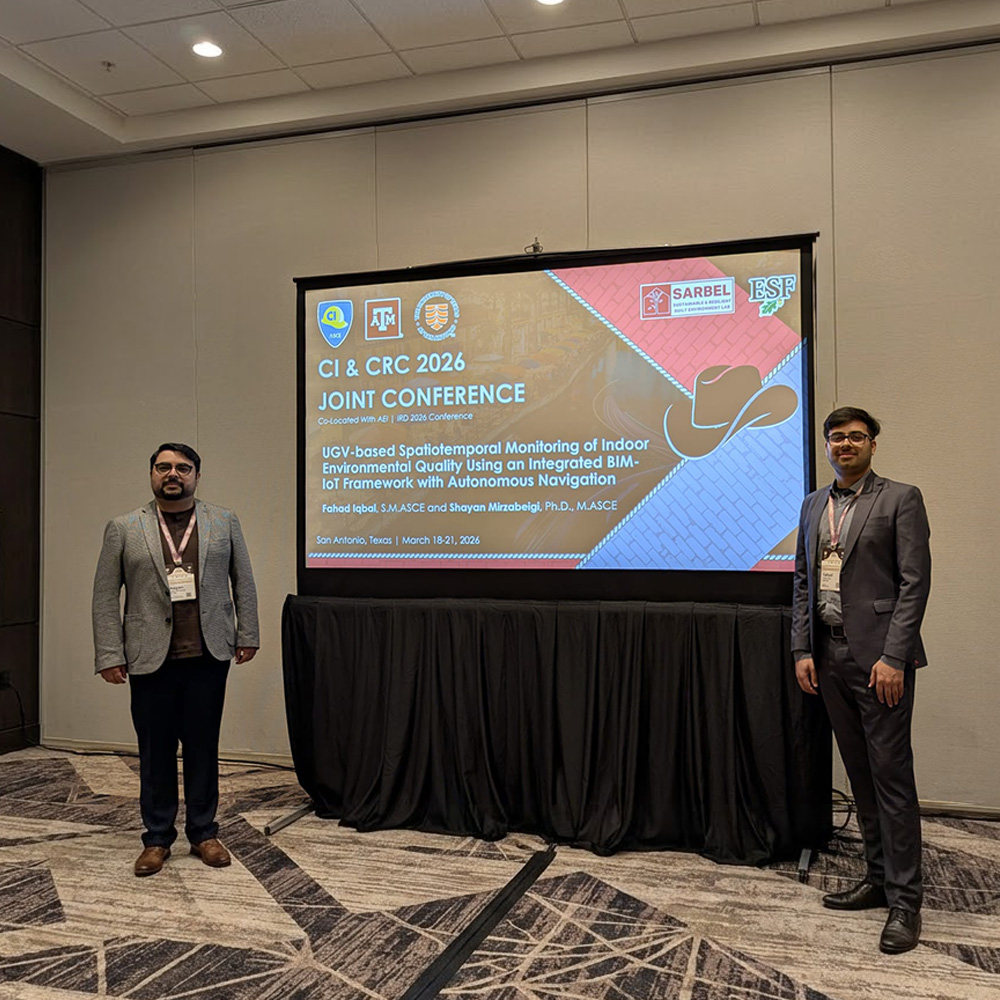
I am very happy to share that I will be presenting my research paper, “UGV-based Spatiotemporal Monitoring of Indoor Environmental Quality Using an Integrated BIM-IoT Framework with Autonomous Navigation” at the ASCE Construction Research Congress (CRC) 2026. My work focuses on a big problem in building management: how to track air quality and temperature accurately across large indoor spaces. Instead of using many expensive sensors fixed on walls, we developed a system where an autonomous robot (UGV) moves through the building by itself, collecting real-time data and connecting it directly to a 3D digital model (BIM).

Potential Applications
Our integrated BIM-IoT framework offers a game-changing approach to building commissioning, especially for verifying that HVAC and environmental systems are performing as designed. Instead of manual spot-checks that only capture a “snapshot” of a room, the autonomous UGV provides a complete spatiotemporal audit. It can identify “dead zones” or imbalances in airflow and temperature that fixed sensors often miss. By mapping this live data directly onto the BIM model, engineers can immediately see if the building meets the required sustainability and comfort standards before handover, ensuring the “as-built” performance matches the “as-designed” goals.
For retrofitting projects, this technology is invaluable for performing deep energy audits in older buildings where original blueprints may be missing or outdated. The UGV can navigate these complex spaces to collect high-resolution environmental data, helping to pinpoint exactly where insulation is failing or where moisture is building up. This precise “as-is” data allows us to create a highly accurate digital twin, which acts as the foundation for planning retrofits. By using this framework, facility managers can prioritize the most critical upgrades, reducing both the cost of renovations and the long-term energy consumption of the building.