
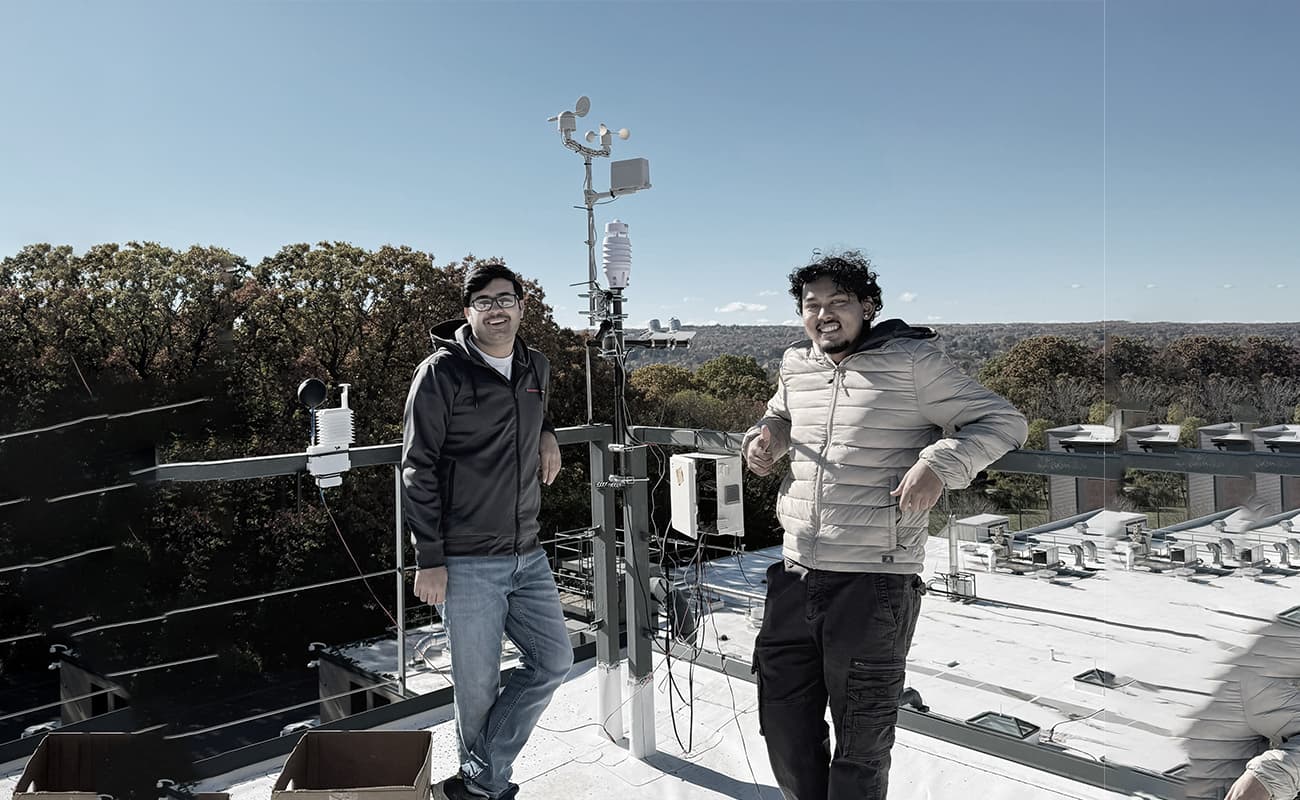
Indoor environmental quality (IEQ) directly affects health, comfort, and productivity, yet universities often lack detailed, campus-wide monitoring. This study introduces a comprehensive IoT-based framework to continuously monitor air quality and thermal comfort across both indoor and outdoor spaces at SUNY ESF. Using 28 custom, low-cost sensor nodes, the system captured PM, CO₂, temperature, humidity, TVOC, noise, light, globe temperature, and wind speed, streaming data to a web-based visualization platform for real-time insights.
Analysis revealed that classrooms and offices frequently exceeded CO₂ and PM thresholds during peak occupancy, while outdoor conditions reflected seasonal and diurnal variations plus city-wide factors like adjacent highway construction. Thermal comfort, estimated with a simplified PMV model, showed that many spaces were outside the optimal range, especially during summer afternoons. Cross-correlation analyses highlighted how outdoor conditions influence indoor environments, while occupancy schedules and HVAC operation misalignments were identified in several locations.
Clustering of sensor data allowed spaces to be categorized by environmental quality, pinpointing problem areas like Lecture Hall 103 Marshall and Bray Class 315 for targeted interventions. Overall, the framework demonstrates that IoT-based monitoring is scalable, cost-effective, and capable of providing actionable insights, supporting sustainability, occupant well-being, and evidence-based campus management.
“Data-driven environmental monitoring transforms how we understand and manage indoor spaces, making buildings healthier, smarter, and more sustainable”
Someone
I don't know!Main aspects of brand design and development
- 28 custom IoT nodes deployed across classrooms, offices, corridors, common areas, and outdoor spaces.
- Real-time web dashboard for monitoring, trend analysis, and indoor–outdoor comparisons.
- Identification of CO₂, PM, and TVOC exceedances linked to occupancy and HVAC operation.
- Thermal comfort assessment using simplified PMV, revealing afternoon and summer stress periods.
- Indoor–outdoor correlation analysis for understanding environmental interactions.
- Clustering analysis for prioritizing interventions in areas with poor IEQ.
- Framework supports scalable, cost-effective, and continuous campus-wide monitoring.
By combining IoT sensing, real-time analytics, and environmental modeling, this study provides a holistic view of campus air quality and comfort, enabling universities to improve building operations, support occupant health, and plan effective retrofit or sustainability strategies.