
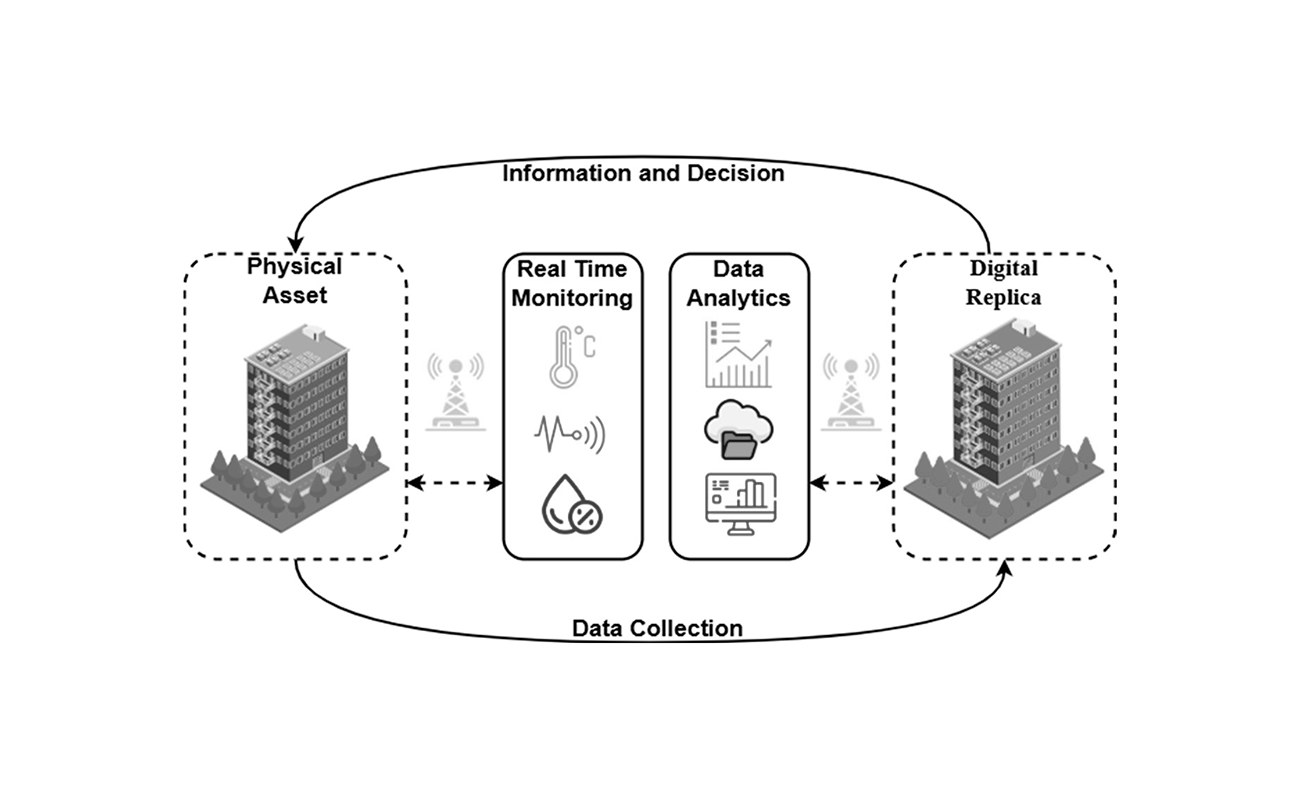
In modern buildings, HVAC systems are responsible for a large portion of energy consumption, yet maintaining occupant comfort remains challenging. Integrating Building Information Modeling (BIM), IoT sensors, and Digital Twin (DT) technology allows real-time monitoring, predictive control, and energy-efficient management of indoor environments. This study proposes a real-time DT framework that combines spatial BIM data, environmental sensor readings, and predictive machine learning models to optimize thermal comfort and HVAC operations.
The framework uses IoT sensors to monitor temperature and humidity, integrates a simplified PMV (sPMV) model to assess thermal comfort, and employs a hybrid ML approach (FB Prophet + LSTM) to predict future indoor conditions. Users can visualize real-time and predicted comfort levels through a web-based interface, enabling both automatic and manual HVAC control. Open-source tools like IFC.js, Firebase, and Plotly.js make the system scalable, cost-effective, and globally deployable.
“Innovation distinguishes between a leader and a follower. It’s not just about creating something new, but about understanding people’s needs and using technology to make their lives better. The most powerful innovations are those that combine simplicity, intelligence, and empathy, enabling people to achieve more than they ever thought possible.”
Steve Jobs
co-founder of Apple Inc.Main aspects of brand design and development
- Real-time sPMV calculation & BIM visualization
- Predictive HVAC control with hybrid ML models
- Interactive web platform for monitoring & control
- Open-source, scalable, cost-efficient architecture
- Reduced sensor needs with accurate sPMV (±0.2)
- Digital Twin enables dynamic asset-model interaction
By integrating BIM, IoT, and DT technologies, the framework provides a data-driven approach to energy-efficient building management while prioritizing occupant comfort. Facility managers can remotely monitor conditions, receive predictive insights, and adjust HVAC operations to balance energy use and thermal satisfaction. This research demonstrates how predictive analytics, real-time visualization, and digital twin frameworks can converge to optimize modern building performance.