
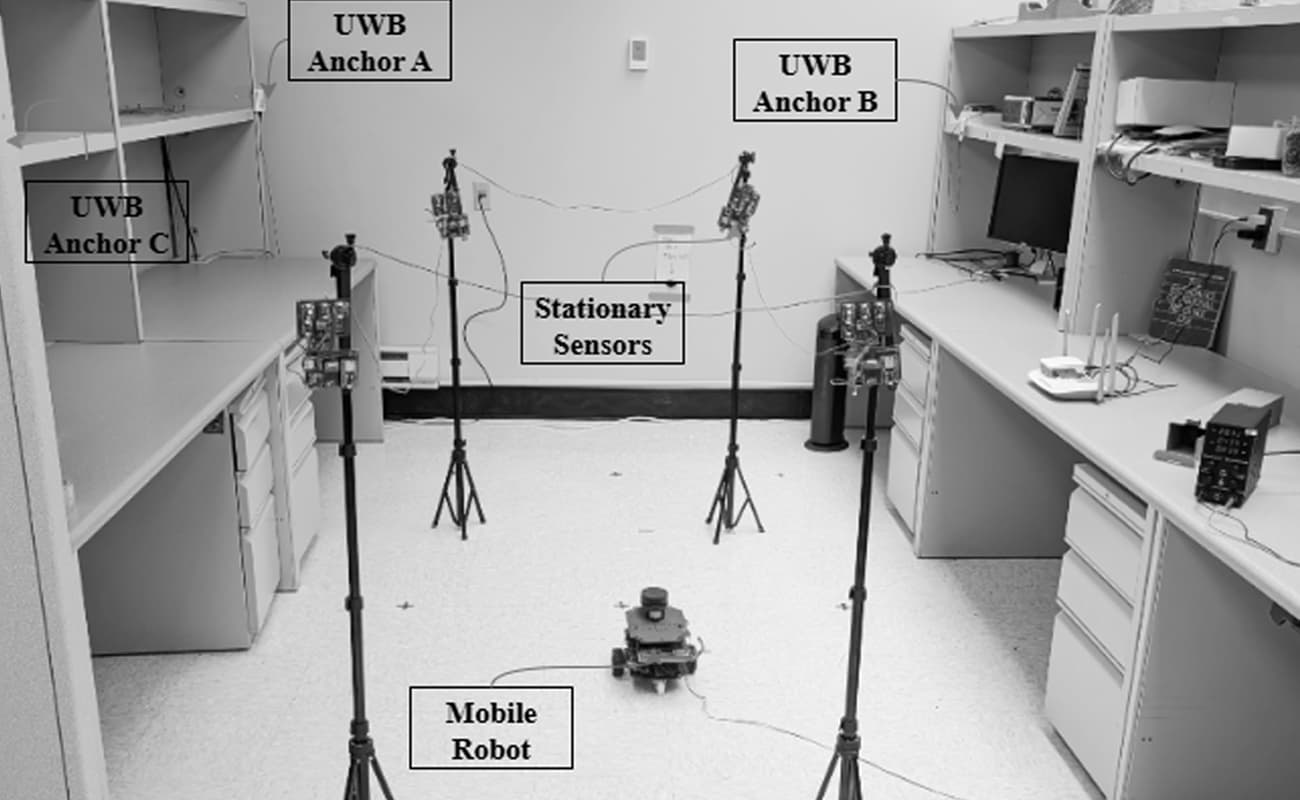
Indoor Environmental Quality (IEQ) is a critical factor for occupant comfort, productivity, and health in smart buildings. Conventional stationary sensors are limited in spatial coverage due to infrastructure and maintenance costs. To overcome these limitations, this study introduces a mobile sensing system using an Unmanned Ground Vehicle (UGV) equipped with temperature, humidity, and CO₂ sensors. By integrating Ultra-Wideband (UWB) localization, Building Information Modeling (BIM), Simultaneous Localization and Mapping (SLAM), and autonomous navigation, the system collects high-resolution spatiotemporal environmental data efficiently.
The UGV navigates indoor spaces using a BIM-based occupancy map, subdividing areas into grids and visiting each point sequentially to capture environmental measurements. Collected data are transmitted to a cloud database and visualized as continuous 2D maps using Inverse Distance Weighting (IDW), producing high-resolution representations of indoor conditions. Positional accuracy is maintained within ±6–8 inches, enabling precise mapping, while the platform remains cost-effective and scalable for real-world applications.
The mobile approach addresses key limitations of stationary monitoring by capturing transient spatial variations, filling blind spots, and providing richer data for building management. By combining BIM, IoT sensors, and autonomous UGV mobility, the system enables dynamic environmental monitoring, supports digital twin applications, and facilitates data-driven decisions for improving occupant comfort and energy efficiency.
“Technology, like art, is a soaring exercise of the human imagination.”
Daniel Bell
Managing Director, BentocaseMain aspects of brand design and development
- Mobile UGV platform for high-resolution spatiotemporal IEQ monitoring.
- Integration of BIM, IoT sensors, UWB, IMU, odometry, and LiDAR for autonomous navigation.
- Organisationa abilities
- Generation of detailed 2D spatiotemporal maps using IDW interpolation.
- Compact design with scissor-lift arm to position sensors at human height.
- Distributed control with Raspberry Pi 4 and KB2040 for precise, low-latency data acquisition.
- Supports digital twin applications for real-time monitoring and intelligent building management.
- Scalable and cost-efficient for deployment in smart buildings.